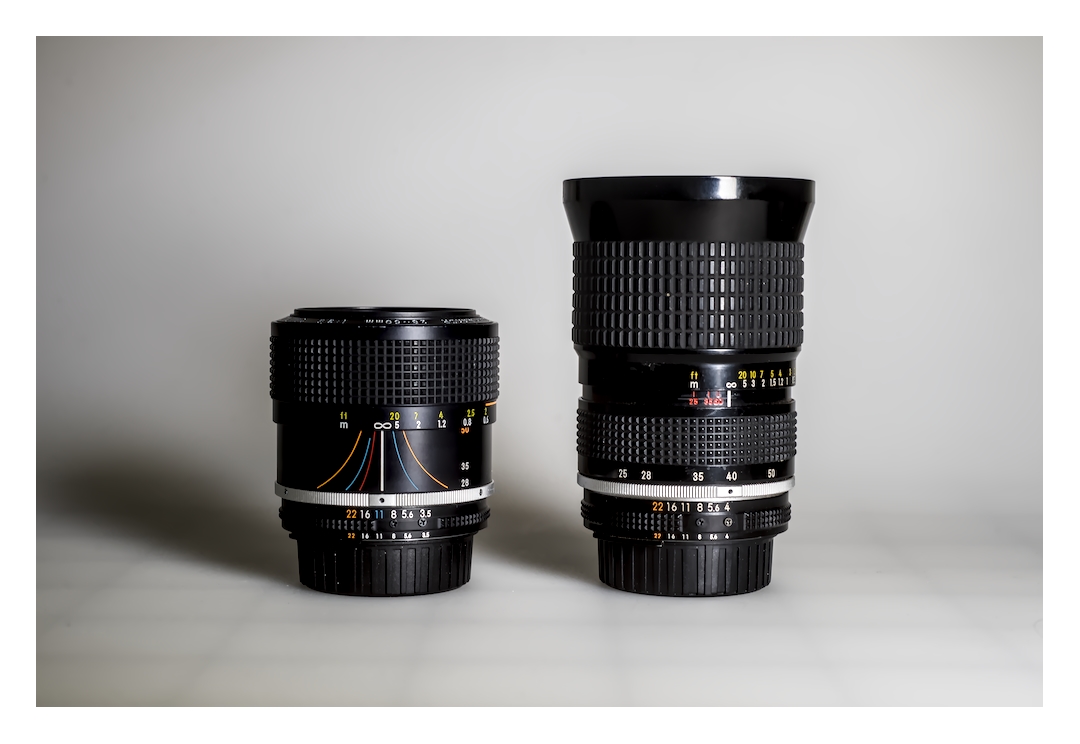
I was almost today-years-old when I even learned this lens existed.
The Nikon 25-50mm f/4 AI-S is one of those forgotten classics that photographers stumble across and wonder, “Wait, how did I not know about this?” Released in 1981 as Nikon’s first professional wide-angle zoom, this lens was a big deal at the time—costing the equivalent of around $2,700 in today’s money. But somewhere between the march of autofocus and the proliferation of 24-70mm zooms, it quietly faded from collective memory.
The Japan Market Thing
Finding one of these stateside has always been a bit tricky. They’re easier to locate in the Japanese market, which makes sense given Nikon’s home turf advantage. I managed to snag mine from Japan before the recent tariff situation turned cross-Pacific lens shopping into a financial headache. If you’re considering one now, be prepared to either pay the tariff premium or hunt domestically—though good luck with that.
It’s Heavy… But Hella Sharp
Let’s address the elephant in the camera bag: this thing has some heft. At over 600 grams, it’s not exactly a lightweight companion for all-day shooting. The build quality is classic Nikon AI-S—solid metal construction, smooth focusing, and that professional-tool feel that modern plastic zoom rings just can’t match.
But here’s the thing: it’s genuinely sharp. Like, sharper than it has any right to be for a zoom from the early ’80s.
What People Say
The lens has developed a bit of a cult following among those who know about it. Reviewers praise its gentle, beautiful rendering—that distinctive quality that separates it from typical clinical Nikon optics. One photographer noted it performs similarly to a prime lens at certain focal lengths, particularly in the sweet spot around 35-40mm.
The consensus seems to be:
- Exceptional close-up performance with impressive sharpness and texture
- Some struggle at infinity focus (copy variation seems to be an issue)
- Prone to vignetting, especially at the wide end
- Beautiful rendering with that “magical look” old Nikkors are known for
- Best performance stopped down to f/5.6-f/8
Several users mention the lens gives images a “rounded,” less digitally harsh quality—perfect for people shots where you don’t want to resolve every skin imperfection. As one reviewer put it, comparing it to the modern AF-S 24-70mm f/2.8, it shows “less purple fringing at f/4” and has “that magical look that some old Nikkors have.”
My Breckenridge Day
I took this lens for a full day of walking around Breckenridge, Colorado, shooting street and mountain scenes. The experience was… interesting. The weight became apparent after a few hours, and I found myself questioning my gear choices. But the images? Those were lovely. That classic Nikkor rendering at 25mm gave the mountain town scenes a character that my modern glass just doesn’t quite capture.
(No - these shots are not showing a natural vignette - it’s how I felt like editing that day)


But Then…
Here’s where it gets weird: I picked up the even more oddball 28-50mm f/3.5 AI-S not long after. And that lens? It lived on my camera for quite a while. Lighter, easier to handle, and that shorter focal range actually landed perfectly - I became a 28mm shooter. The 25-50mm went back in the bag.
Would I Recommend It?
Absolutely. YES.
It’s a fantastic lens for anyone who appreciates classic Nikkor optics, wants that 25mm wide angle, and doesn’t mind the weight. The image quality is genuinely impressive, especially considering its age. The rendering is beautiful, with that vintage character modern lenses often lack.
But Then Why Don’t I Use It?
Huh. Good question.
I think it comes down to that weight-to-use ratio. The 28-50mm f/3.5 delivers 90% of the experience at a fraction of the heft. And in street photography, where I’m walking miles at a time, every gram matters. The 25-50mm is the lens I’m glad I own, the one I’d never sell, but also the one that sits in the bag more than it should.
Maybe that’s the perfect definition of an oddball lens: technically excellent, optically impressive, historically significant… and somehow still gathering dust while lesser lenses get all the shooting time.
If you find one at a good price, grab it. Just don’t be surprised when you find yourself reaching for something lighter.
For more information about this lens, it is featured in One Thousand and One Nights #46 at Nikon.com.