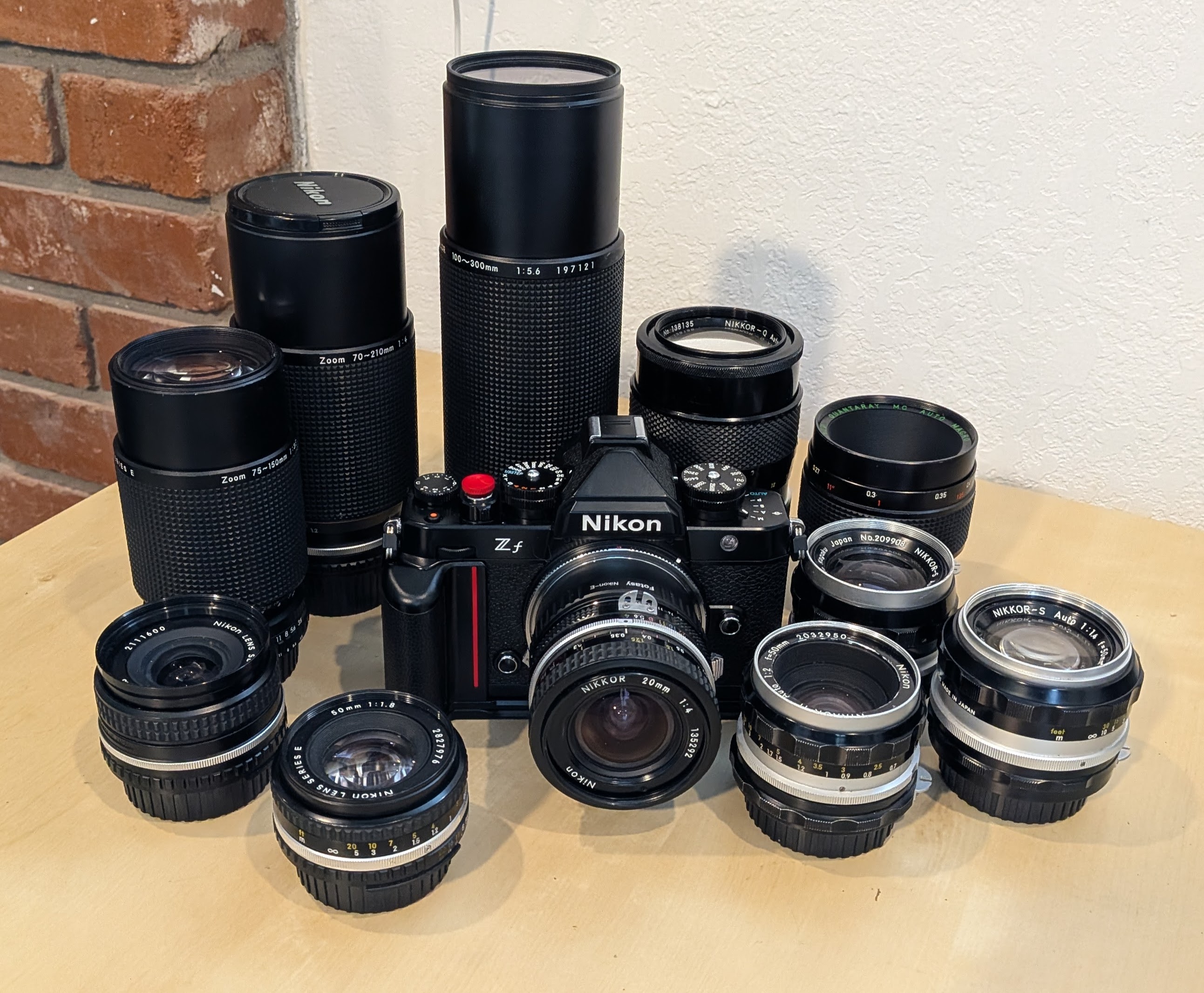
The Nikon Zf is a phenomenal camera for manual focus photography. Whether you’re mounting vintage AI-S glass or modern manual focus lenses like the Voigtlander Z-mount series, these lenses feel right on this camera. The ergonomics, the tactile feedback, the deliberate nature of manual focusing—it all clicks. There’s just one problem: Nikon has artificially restricted one of the camera’s most useful features in a way that makes no technical sense.
The Focus Confirmation Problem
Here’s what should be simple: when you nail focus with a manual lens, the focus indicator in your viewfinder should turn from red to green. It’s a small thing, but it’s incredibly helpful for confirming critical focus, especially in challenging lighting or with shallow depth of field.
If you’re using a chipped lens—like the excellent Voigtlander Z-mount manual focus lenses—this works perfectly. The red box turns green when you hit focus, giving you instant confirmation. But if you’re using a non-chipped lens, whether it’s a vintage Nikon AI-S gem or a modern third-party manual focus lens without electronic contacts, you get nothing. The camera is perfectly capable of detecting focus; it just won’t tell you about it.
This isn’t a technical limitation. The camera’s phase-detect autofocus system can absolutely determine when the image is in focus regardless of what lens is mounted. Nikon has simply chosen not to enable this feature for non-chipped lenses. My strong suspicion is that this is a business decision—specifically to protect licensing revenue from the chip interface that manufacturers like Voigtlander pay to implement. It’s the kind of artificial restriction that benefits Nikon’s bottom line while making the user experience unnecessarily worse.
The Workaround: Chipped Adapters
The good news is there’s a workaround, though it’s far from elegant. You can use an adapter that includes electronic contacts to spoof a chipped lens. There are several options available:
- The Neewer E-to-Z adapter and similar (My choice. Neewer NW-ETZ PRO - designed for Sony E lenses)
- A Viltrox F-to-Z adapter with chip (Viltrox NF-Z)
- Various Leica M-to-Z chipped adapters (though these may cause vignetting with some lenses)
- UPDATE JUNE 2026. There’s a new player in town, the FUNMOUNT NF-Z. A direct F to Z adapter with 12 configurable slots for focal length - that I don’t understand at all yet. Just bought one to test further from here https://www.amazon.com/dp/B0G8YFQLNG and I will update this page as soon as I can.
One reason I chose the Neewer is that with the right “dumb” adapter ( I use a K&F Concept NIK F-E), it looks perfect.. especially with the lens “rabbit ears” removed.


Notably missing from this list is Nikons own F2Z II adapter - coming in a whopping $250, this Nikon product, primarily aimed at adapting Nikons last generation of AF lenses does NOT unlock focus assist for manual lenses!
I’ve been using the Neewer E-to-Z adapter paired with a simple F-to-E adapter ring for my vintage Nikon lenses. This setup unlocks focus confirmation completely—the red box turns green just as it should. Problem solved, right?
Not quite.
The IBIS Problem
By default, the Neewer adapter tells the camera it’s a 50mm lens. That means the in-body image stabilization calibrates itself for a 50mm focal length. Mount a 200mm lens and you’ll get insufficient stabilization for the actual focal length. Mount a 20mm ultrawide and you might experience a weird, laggy effect through the viewfinder as the IBIS system overcorrects.
You can connect the Neewer adapter to a computer and edit a configuration file to change the spoofed focal length, but this is completely impractical for real-world shooting. Who wants to pull out a laptop to change adapters between lenses?
Here’s the real kicker: because the adapter is telling the camera it’s working with a chipped lens, the firmware’s “Non-CPU Lens” feature is disabled. This feature normally lets you manually tell the camera what focal length you’re using for proper IBIS calibration. But Nikon’s firmware logic says “if there are electronic contacts, ignore the manual settings.” You literally can’t work around this within the camera’s menu system.
The Business Cost
While this limitation has pushed me toward buying Voigtlander lenses—and they truly are excellent—I still have a collection of glorious Nikon AI-S lenses that I’d love to use with both focus confirmation and properly calibrated IBIS. These are superb pieces of glass that deserve better than being relegated to second-class status on a modern Nikon body.
The frustrating part is how unnecessary this all is. Nikon could enable focus confirmation for all manual focus lenses tomorrow with a simple firmware update. The technology is already there in the camera. They’re choosing not to, and it feels like that choice is driven by business development considerations rather than any concern for user experience.
It leaves a sour taste. The Zf is positioned as a camera for enthusiasts who appreciate manual focus photography and vintage glass. Yet Nikon has hobbled one of the features that would make that experience truly excellent. For a company that built its reputation on the strength of its F-mount lens ecosystem and the enthusiasts who still treasure those lenses, this feels like a betrayal of that legacy.
Focus confirmation for manual focus lenses should just work. There’s no good technical reason it doesn’t. And that’s what makes it so annoying.