There’s a pattern in my life that I’ve only recently recognized. Over the last 25 years, I’ve bought a series of cars that became progressively more expensive and substantially less exciting. Each one promised more features, more comfort, more technology. And each one delivered exactly that—along with a growing sense that something essential had been engineered away.
Then I bought a 1998 BMW Z3.
There’s nothing quite like throwing around a light car with a manual transmission. It’s a simple machine. No bloat. Just fun. A simple little screamer of an engine that gets the job done. No lane assist trying to correct my steering. No screen demanding my attention. Just me, the road, and a perfectly balanced chassis that weighs about as much as a modern Civic’s driver’s seat.
I feel the same way about lenses. What happened?
The Growing Burden
Let’s talk numbers, but not just weight—heft. That physical bulk that changes how a lens handles, how it fits in your bag, and whether you actually want to carry it for eight hours.
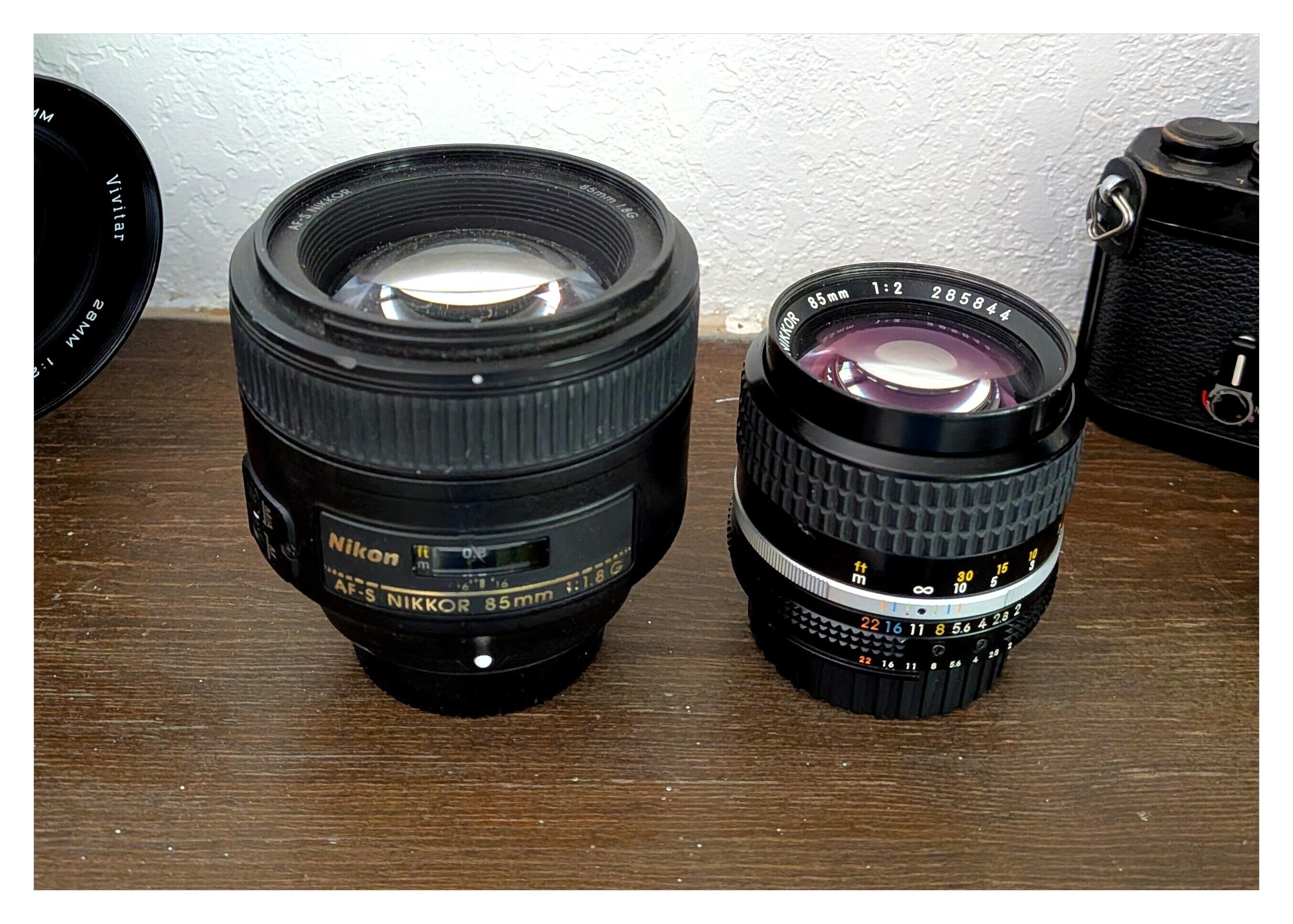
The Nikon 85mm f/2 AI-S—the lens sitting on my shelf right now—weighs 310 grams and measures approximately 71mm in diameter. It’s a solid piece of glass and metal that feels substantial without being burdensome. Compact. Elegant. Purposeful.
Fast forward to the AF-D era. The 85mm f/1.8D actually got lighter at 380 grams, though much of that came from cheaper materials and plastic construction. But look at what happened with the G series: the 85mm f/1.8G weighs 350 grams—lighter on paper than the AI-S—but it balloons to 80mm in diameter and 73mm in length. It’s chunkier, bulkier, harder to pack. The svelte profile is gone.
Then Z-mount arrived and things got serious. The Z 85mm f/1.8 S weighs 470 grams and stretches to 99mm in length with an 75mm diameter. We’ve added significant bulk to that classic form factor. Want f/1.2? The Z 85mm f/1.2 S is a 1,160-gram monster at 125mm long and 90mm diameter. That’s nearly four times the weight of the AI-S f/2, and substantially larger in every dimension.
This isn’t cherry-picking. Look at the 35mm lineup: the AI-S f/2 was a pocketable 205 grams. The Z 35mm f/1.8 S is 370 grams—nearly double. The classic 50mm f/1.8 AI-S was a featherweight 155 grams. The Z 50mm f/1.8 S? A hefty 415 grams. Nearly triple.
Why the Heft Gain?
The D series brought the first major change: built-in autofocus motors. Nikon’s screwdriver AF system initially kept things relatively compact, but when they moved to Silent Wave Motors (SWM) in the G series, every lens needed its own focus motor, control electronics, and additional mechanical elements. The lenses didn’t necessarily get heavier, but they got bigger, chunkier, less elegant.
VR (Vibration Reduction) added another layer of complexity—literally. Those floating lens elements, gyroscopic sensors, and compensating motors all take space and weight. Granted, VR hasn’t affected the 85mm lineup much, but look at any telephoto or zoom lens from the past two decades and you’ll see the impact immediately.
Then came the mirrorless transition. Z-mount lenses needed to be redesigned from scratch for shorter flange distances. Nikon took this opportunity to pursue optical perfection with their S-line glass. More elements, exotic glass types, nano coatings, and larger rear elements to take advantage of that wider mount diameter. The result? Spectacular optical performance and brick-like heft.
The Practical Impact
When my main camera was a D850, traveling meant choices. I could take the camera and four lenses, which consumed most of a full-sized carry-on and weighed enough to make me question my life decisions by the end of a walking tour. On any given shoot, I’d either choose carefully which two lenses I needed, or I’d suck it up and backpack the whole lot. Neither option was fun after hour three.
Now that my main camera is a Zf, I can travel with four lenses that fit comfortably in a 3L sling bag. On my recent trip to Ireland, I packed eight AI-S primes and my trusty 28-50mm zoom, and all of that fit in an 6L camera bag. Eight lenses versus four. Smaller bag. Less weight. More creative options.
The difference isn’t just about grams on a scale—it’s about the physical space these lenses occupy and how that affects your entire shooting experience.
Better or Just Different?
It’s just the way it is—but is it better?
Modern coatings are absolutely spectacular at controlling flare. Point a Z-mount lens directly at the sun and you’ll get clean, contrasty images that would have been impossible thirty years ago. AI-S era lenses were decent, although shooting across strong light with the 85mm AI-S definitely requires a lens hood unless you’re going for that dreamy, veiled look.
Sharpness? Modern glass is almost too sharp. Perfect corner-to-corner resolution across the entire frame, even wide open. Everything rendered with clinical precision.
But here’s the thing: the old lenses have character. Buckets of it. There’s a quality to how they render out-of-focus areas, a certain three-dimensional quality to their imaging, a gentle rendering of skin tones that just feels… right. I’ve shot with some modern lenses where I find myself adding character in post-processing—a bit of glow, some softness to the highlights, maybe reducing that clinical sharpness just a touch. They’re great and all, but they don’t have the same soul.
The Middle Way
Let me finish with a shout-out to the Voigtlanders. They represent a very happy medium. Sure, they’re a bit bigger than vintage glass—my 50mm f/2 APO-Lanthar weighs 434 grams compared to the 155-gram AI-S—but they’re nothing like their modern Nikon counterparts. They bring contemporary optical design and coatings while maintaining that manual-focus ethos and relatively compact form factor. And somehow, they manage to preserve some of that rendering character I love about vintage glass.
Just like my Z3 splits the difference between a vintage sports car and a modern luxury sedan, these lenses find a sweet spot between classic simplicity and contemporary performance.
Sometimes less really is more. Or at least, sometimes less is more fun. And isn’t that what photography is supposed to be?